
In the middle of the 19th century the southern tip of the old parish of Pinner was almost devoid of features. Yet in the extreme south, lying against a hedge which formed the boundary of the parish, and almost masked by it, was a rifle range.
The range was 950 yards long and below you can see its relationship to today’s street plan.
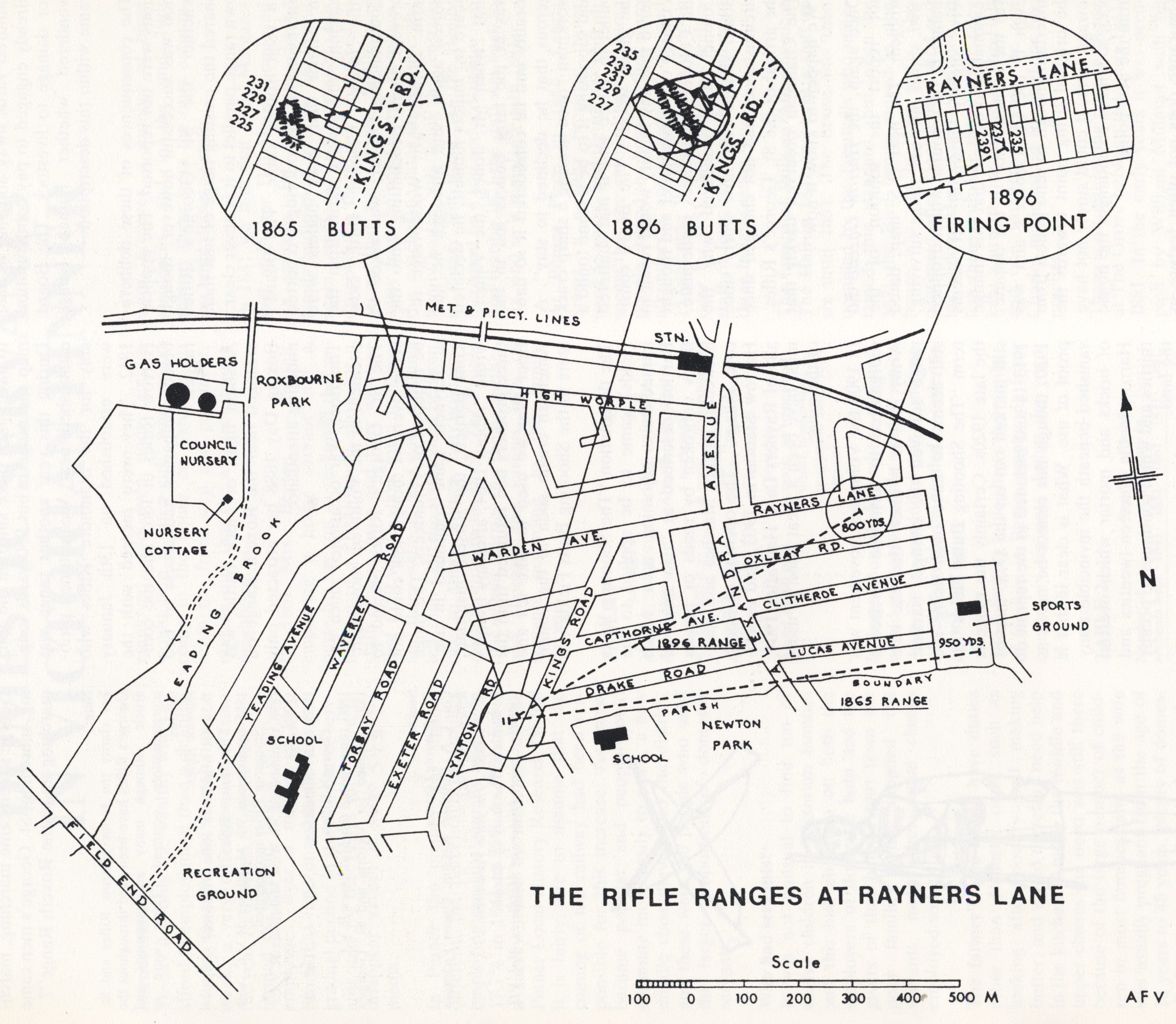
The butts behind the target were a high and thick mound of earth designed to stop the bullets. By 1896 the range had been shortened to 800 yards and realigned with a new firing point slightly to the north, but with target and butts scarcely altered.
The range was established as the result of a wave of alarm which swept Britain in 1859 after President Louis Napoleon of France had declared himself Emperor and appeared to consider invasion of England to recover certain French refugees. Sixty years earlier local volunteer militia had been raised when his uncle Napoleon Bonaparte had threatened invasion, but these were disbanded between 1805 and 1815.
Reluctantly the Government sanctioned the formation of Volunteer Rifle Corps in May 1859 provided there was no cost to the public purse. This was later modified by the issue of rifles, but other equipment, uniforms, drill halls and ranges had to be provided at private expense.
In Harrow, a meeting held on 1st November 1859 sought to arouse support and find a rifle range. Ten days later a general meeting was convened at Harrow School under the chairmanship of the Headmaaster. John Charles Templer explained the organisation of a volunteer company to an enthusiastic audience. The Government would provide Long Enfield rifles, but a drill sergeant would cost the company one shilling a day. About thirty people enrolled at this meeting and some £200 was raised. On 30th December 1859 the Middlesex Volunteer (Harrow) Rifles were formed and J.C. Templer was commissioned as their Captain.
On 7th January 1860 the Volunteers took the oath, and met on 21st to choose a uniform, dark green with black facings. By April of that year the Corps was fully armed and equipped and sent a contingent of fifty-six privates, one N.C.O. and three officers to the Grand Volunteer Review by Queen Victoria at Hyde Park on 23rd June.
Drill was held near Grange Farm at Roxeth. In June 1860 the Harrow Gazette reported that “an excellent ground for … rifle practice … has been secured upon the farm of Messrs. Hodsdon, upon the Uxbridge Road, Roxeth. It presents 1000 yards range, is level for its entire distance, and, running along the line of a hedge, interferes but little with the enjoyment of the lands. The butts are now being erected … but … wet weather has retarded the earthwork”.
Hodsdon’s farm became Tithe Farm in Eastcote Lane. The farm was largely given over to livestock and hay products. Gaining access to the range must have been tedious for many years, involving either a lengthy walk along Rayners Lane from Pinner Road in the north or from Eastcote Road in the south, or perhaps more directly across footpaths from the Northolt Road.
This problem, and even greater ones, did not quench the enthusiasm of the Volunteers. The Gazette reported on 1st September 1860, “Every day has seen several members of the Corps hard at work on the new range at Mr. Hodsdon’s farm, and this notwithstanding that the lane leading to the spot has been several times more than knee deep in water and that the shooters have been over their ankles in mud”.
Luckily the call to repulse the French never came. By 1884 it seems that the Harrow Rifles had more permanent company at the butts. In March Mr. Priest, who was now the farmer at the Tithe Farm, applied for the erection of a new butt adjoining the existing one, for the use of the St. George’s Rifles. They had been formed in August 1859 in the faraway parish of St. George, llanover Square.
Two factors probably influenced their choice of Harrow for a new range. Firstly, this part of Middlesex had become much more easily accessible from London since the Metropolitan Railway had opened its station at Harrow in 1880. Another station was scheduled shortly for Pinner. Secondly one of the chief officers of the St. George’s was Stanley George Bird.
Bird had been a major with the St. George’s since 1878 and was their Colonel in Command from 1885 to 1889. Though not himself local to Harrow, his father George Bird had bought one of the largest and most elegant estates in Pinner in 1865, namely The Hall, near the junction of Paines Lane and Uxbridge Road.
There was, however, a complicating factor. Pinner’s first sewage farm had been established in 1880 at the southern tip of Cannon Lane and a cottage had been built, which still survives, for the sewage workers. The Sanitary Board feared that the proposed second range would be in line with this cottage. Major Bird pointed out that the butts were at least five hundred yards away. The application was successful however, though whether the St. George’s Rifles shared the existing range or had their own range parallel to it is never clear.
In 1888 trouble came, Mr. Woodbridge, reported in March that stray bullets were reaching the sewage farm from the rifle range. Colonel Bird, was asked to prevent them ricochetting onto the farm. In May Mr. Woodbridge reported again, and although he had heard no bullets himself, he declared that when Mr. Jones was at the farm “bullets fell in the locality and he considered it so dangerous that he declined to stay”. A workman “once hearing a sharp crack and supposing it to be a stone found a bullet in a tree and it had shattered the green wood”. The Board considered that any fatality would result in a charge of manslaughter and thought the Colonel’s assurances inadequate.
The next O.S. map, dated 1896, shows only one range surviving, realigned, on a course which dropped very slightly downhill. It seems reasonable to assume that this change was the consequence of the dispute.
Shooting contests are announced between different companies of the Harrow Rifles and also between corps not connected with the 9th Middlesex, though the range is sometimes not named. They may not always have been at the Rayners Lane, or as it was called then, the Roxeth Range. During 1862 another range was established near Wealdstone, probably for the Stanmore Rifles who were established on 13th January 1862. They were merged with the Harrow Rifles in 1865 and the combined companies had access to two ranges.
Tom Bartlett, the Roxeth historian, wrote “About 1904, after my friend’s three brothers had returned from the Boer War we used to take tea and American cream soda to the volunteers in the Shooting Butts Fields”.
The designation “The Shooting Butts Fields” came to be applied to the immediately adjoining area which Bartlett described as “two miles of fields unbroken by roads or houses betweeen Roxeth Marshes and Eastcote Village”. The opening of South Harrow Station in 1903, and especially of Rayners Lane Halt after 1904, must have been a great boon to users of the range.
In 1908 the Volunteer movement was reorganized to form the Territorial Army, but it is likely that the rifle range survived the change. Bartlett still seems to have been using the term “The Shooting Butts Fields” in the late 1920s. Certainly the range is still marked out on the O.S. map of 1913-14 and included in the reprint of 1920, though this cannot be taken as proof of use. What is clear is that it vanished beneath the invincible army of bricks and mortar which overran Harrow in the nineteen-twenties and thirties.
Pat Clarke of Pinner Local History Society muses, in the source article for this page:
What if Rayners Lane had been called Shooting Butts Lane instead? What might then have been the name of Rayners Lane Station? Why was Shooting Butts not used in some way instead of Drake Road and Lucas Avenue? And, to paraphrase a line from the poem “The Highwayman’ when was the last time that “St. George’s men came marching, marching, marching, St. George’s men came marching up to the Roxeth Range”?
Note: The terms Harrow Rifles and St. George’s Rifles have been used throughout the article although many amalgamations and reorganizations occurred.

 Rayners Lane